Vercel vs Railway: Frontend Platform vs Backend-First PaaS
Updated 2026-05-06
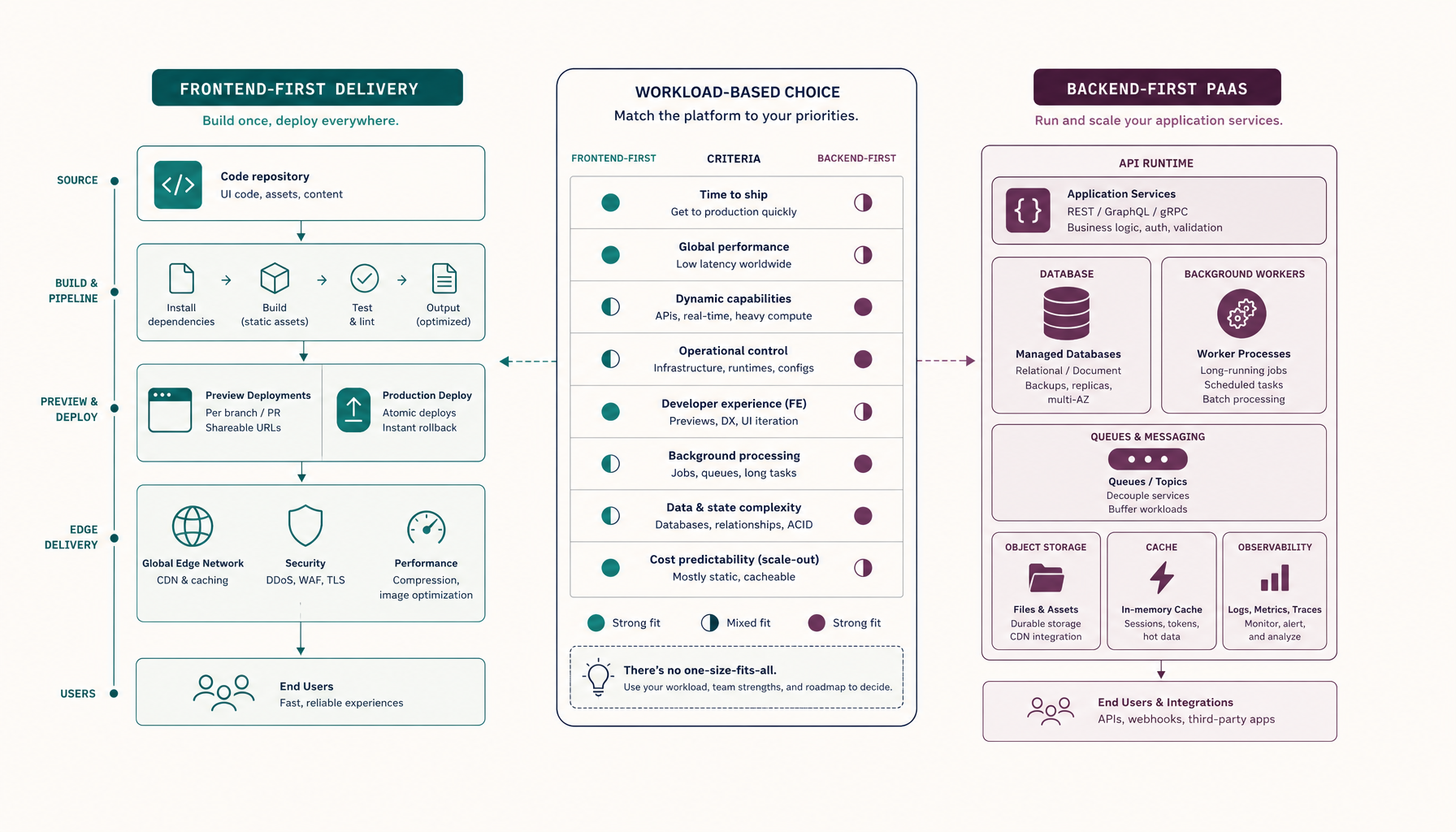
Quick answer: Pick Vercel if your app is frontend-heavy with serverless functions. Pick Railway if you need databases, workers, and backend services in one place.
Comparison Table
| Criteria | Vercel | Railway |
|---|---|---|
| Pricing model | Usage-based (bandwidth, functions, builds) | Resource-based ($5 min + usage) |
| Best for | Next.js, frontend, edge functions | Full-stack apps, backends, databases |
| Database support | External only (Supabase, Planetscale) | Native Postgres, Redis, MySQL |
| Ease of setup | Easy (git push) | Easy (git push) |
| Scalability | Auto-scales, global edge | Auto-scales, single region default |
| Build minutes | 6000/mo on Pro | Unlimited on paid plans |
| Verdict | Best for JAMstack and edge | Best for backend-first apps |
Vercel Overview
Strengths
- Unmatched Next.js integration and optimization
- Global edge network with automatic routing
- Zero-config deployments for most frontend frameworks
- Preview deployments on every PR
- Strong caching and ISR support
Weaknesses
- Usage pricing becomes unpredictable at scale
- No native database or persistent services
- Serverless functions have cold start latency
- Backend-heavy apps require external services
- Bandwidth costs add up quickly
Best for
- Next.js applications
- Static sites with dynamic edges
- Teams prioritizing DX over cost control
- Marketing sites and landing pages
Railway Overview
Strengths
- Deploy any Docker container or language
- Native Postgres, Redis, and MySQL databases
- Predictable resource-based pricing
- Great for monorepos and multi-service apps
- Simple environment variable management
Weaknesses
- No edge network (single region by default)
- Less optimized for pure frontend workloads
- Smaller ecosystem of templates
- No built-in image optimization
- Less mature than Vercel for static assets
Best for
- Full-stack applications with databases
- Backend APIs and workers
- Teams wanting all services in one platform
- Projects that outgrow serverless limits
When to pick Vercel
Pick Vercel if:
- You are building a Next.js or frontend-first app
- Edge performance and global CDN matter most
- You want the fastest path from code to production
- Your backend is already handled elsewhere (Supabase, external APIs)
- Preview deployments are critical to your workflow
When to pick Railway
Pick Railway if:
- You need databases and backend services together
- You want predictable pricing without usage surprises
- Your app has workers, cron jobs, or background tasks
- You prefer resource-based billing over function invocations
- You are building a traditional backend or API-first product
Verdict
Neither platform is universally better. Vercel is the clear winner for frontend-heavy, edge-first applications, especially Next.js. Railway wins when you need a complete backend stack with databases and workers in one place.
For teams building full-stack apps that need both: consider Railway for your backend services and a VPS for long-term cost control, or evaluate whether a self-hosted stack gives you more flexibility.
Where to go next
Tutorials:
Related comparisons:
ServerCompass:
Final verdict
Depends on workload
Vercel wins for frontend-heavy apps; Railway wins for backend services and databases.