Vercel Alternatives (2026): Pay Less, Keep Speed
Updated 2026-05-14 · 14 min
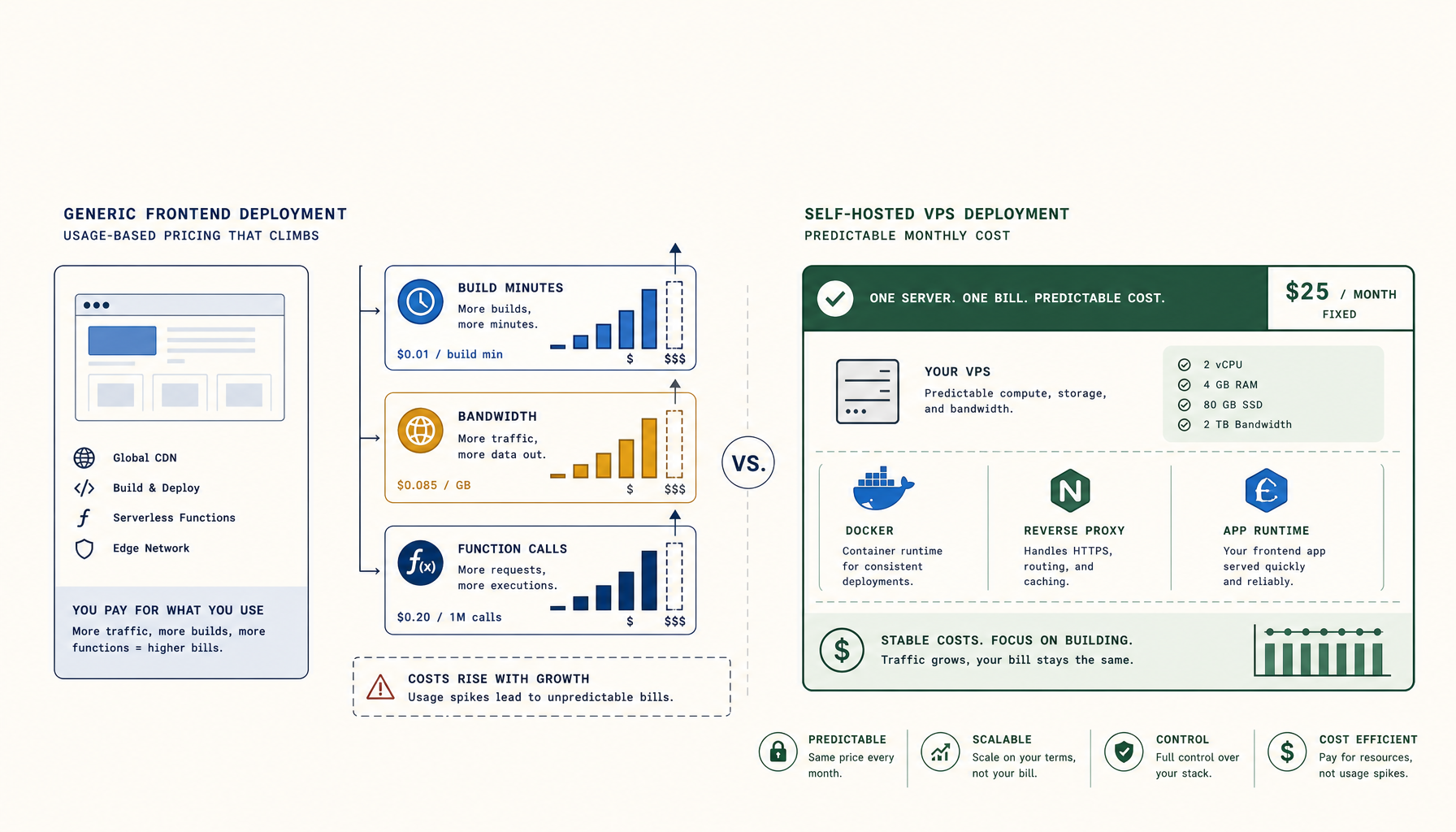
If your Vercel bill is creeping up, it is not because you did something wrong. Vercel is designed to feel frictionless, and frictionless usually costs more than you expect once you have real traffic, real builds, and more than one environment.
This guide is opinionated on purpose. You are not here for "it depends". You are here to pick a path that keeps your deploy speed while making your cost predictable.
Why developers leave Vercel
Most teams leave Vercel for one of these reasons:
- Usage pricing becomes a second job. Bandwidth, edge/function invocations, build minutes, image optimization, logs. Each line item is fine until you have three of them at once.
- Backends become "outside of Vercel". The moment you add Postgres, Redis, background jobs, and queues, you are already running a platform, just spread across vendors.
- You want control and portability. You can absolutely run Next.js elsewhere. The hard part is not "can it run". The hard part is the boring infrastructure glue (TLS, reverse proxy, rollbacks, deployments).
The comparison table (fast shortlist)
| Option | Best for | What you trade | Cost signal |
|---|---|---|---|
| Railway | small backends, prototypes | less edge magic, more app-first | $15 to $60+ |
| Fly.io | global latency, "infra but not a VPS" | more ops than Vercel | $10 to $50 |
| Coolify | DIY platform on a server | time, maintenance, upgrades | server cost + time |
| Dokploy | simpler self-hosted deploy UI | smaller ecosystem | server cost + time |
| Self-hosted VPS | predictable cost, stable traffic | you own the ops | $6 to $25 |
| ServerCompass | Vercel-like workflows on your VPS | one-time tool cost | VPS cost + tool |
If you want the simplest rule:
- If you have one app and you are still iterating, Vercel is fine.
- If you have multiple services or you care about monthly predictability, move to a VPS-based stack.
Alternative 1: Railway (good for backends, mediocre for "Vercel replacement")
Railway is a strong "deploy my backend" platform. For many teams it is the first stop after Vercel, because it keeps the "push to deploy" feeling.
Where Railway wins:
- You can deploy a Node app plus Postgres in minutes.
- The UI is straightforward.
- The cost is more predictable than Vercel for backend-heavy workloads.
Where Railway loses:
- If your app is front-end heavy, Railway does not replicate the Vercel edge ecosystem.
- You still end up stitching together DNS, proxy, and background jobs as you grow.
When to pick Railway:
- Your main pain is deploying a backend (APIs, workers, cron).
- You are okay with platform pricing in exchange for speed.
Alternative 2: Fly.io (best "middle ground" if you are comfortable with infra)
Fly.io is often the best "I want more control than Vercel, but I do not want to babysit a VPS" option.
Fly wins when:
- You want multi-region latency without designing it all yourself.
- You can read logs, understand deploy config, and tolerate a bit more setup.
Fly loses when:
- You want the simplest possible experience.
- You are trying to avoid learning the basics of networking, TLS, and resource sizing.
Cost reality check:
Fly can be cheap, but bandwidth and storage are where teams get surprised. It is still typically less chaotic than the Vercel usage soup once you scale.
Alternative 3: Coolify (self-hosted PaaS if you can commit to maintenance)
Coolify is popular because it looks like "run your own Heroku". It can be great, but it is not free. You pay with time.
Coolify wins when:
- You want a central UI for multiple apps on one server.
- You are comfortable owning upgrades and debugging.
Coolify loses when:
- You want boring reliability without being on call for your own control panel.
If you pick Coolify, treat it like production software you must maintain: backups, upgrades, monitoring, and a rollback plan.
Alternative 4: Dokploy (simpler self-hosted deploy UI)
Dokploy tends to appeal to teams who want:
- a lighter UI
- a smaller surface area
- fewer "platform" concepts
It is usually a good fit if you are already set on a VPS and want a UI, not another vendor.
Alternative 5: Self-hosted VPS (the value winner for most teams)
This is the boring answer, and boring is what you want for hosting.
The typical "starter" VPS path looks like:
- Hetzner (or similar) for predictable compute cost
- Docker + Docker Compose
- a reverse proxy (Traefik or Nginx)
- backups (volume snapshots + DB dumps)
Why it wins:
- Your cost becomes mostly flat.
- You can host multiple services on one server.
- You are not locked into a vendor runtime.
What you must accept:
- You will spend a day learning the setup the first time.
- You must have a recovery plan (backups + how to redeploy).
If you are allergic to ops, do not do this. But if your bill matters, this is the strongest long-term move.
Alternative 6: ServerCompass (Vercel-like deploys on a VPS)
ServerCompass exists for a very specific pain:
You want the predictable cost of a VPS, but you do not want to rebuild the same deployment glue for every app.
If that is you, start here:
- ServerCompass vs Vercel: https://servercompass.app/compare/vercel?utm_source=deployhandbook&utm_medium=referral&utm_campaign=cta
Verdict: what I recommend in 2026
If you are paying meaningful money on Vercel and your app is not a pure static marketing site, the winner is:
Self-hosted VPS, with a deployment workflow you can repeat.
Vercel stays excellent for prototypes and fast iteration. But for most teams, the moment you have stable traffic and more than one service, a VPS wins on budget and control.
Where to go next (internal links)
- Tutorials:
/deploy/nextjs(Deploy Next.js to a VPS)/self-host/supabase(Self-host Supabase)
- Comparison:
/compare/railway-vs-render
- ServerCompass:
Related in the StoicSoft network
If you're self-hosting on a VPS or working through a deployment guide like the one above, DeployToVPS is the StoicSoft network's handbook for VPS deployment recipes — docker-compose, nginx, traefik, and common app self-hosts.