Railway vs Render: PaaS for Developers Compared
Updated 2026-05-14 · 9 min
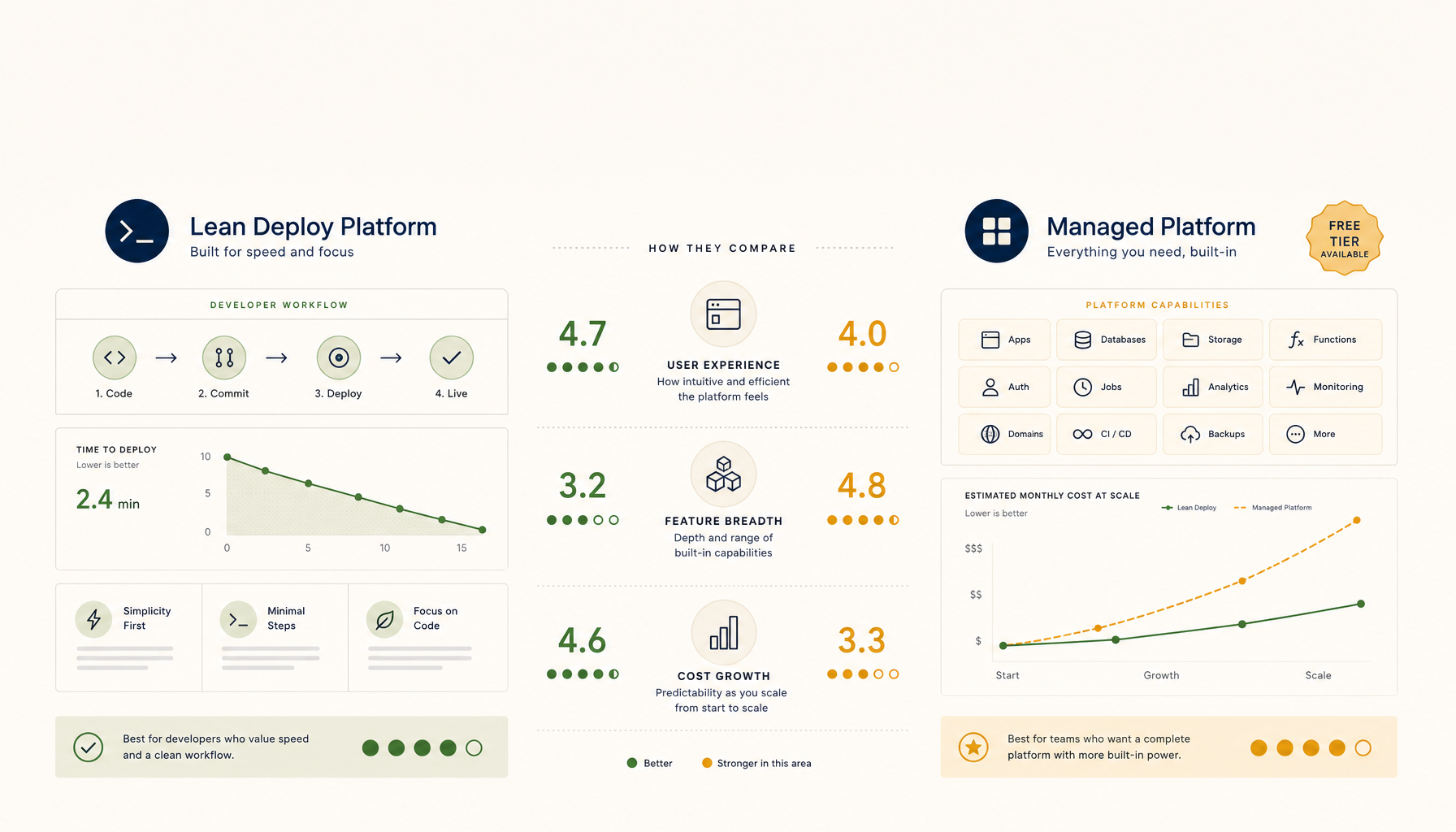
Quick answer: Railway wins for developer experience and startup speed. Render wins for feature breadth and free tier.
Comparison Table
| Criteria | Railway | Render |
|---|---|---|
| Starting price | $5/mo (usage-based) | $0 (free tier) |
| Free tier | $5 credit/mo | 750 hours/mo (sleeps) |
| Deploy speed | Very fast | Fast |
| Database | Built-in PostgreSQL, Redis | Managed PostgreSQL, Redis |
| Cron jobs | Yes | Yes |
| Private networking | Yes | Yes |
| Docker support | Yes | Yes |
| Monorepo support | Excellent | Good |
| DX focus | Primary | Secondary |
Railway Overview
Railway is a newer PaaS focused heavily on developer experience. It's known for its clean UI and fast deployments.
Strengths
- Exceptional DX. The dashboard is clean, fast, and intuitive.
- Fast deployments. Consistently quick build and deploy times.
- Great monorepo support. Handles complex project structures well.
- Usage-based pricing. Pay for what you use, not fixed tiers.
- Instant databases. Spin up PostgreSQL or Redis in seconds.
Weaknesses
- No true free tier. $5 credit runs out quickly with always-on services.
- Smaller feature set. Fewer managed services than Render.
- Newer platform. Less battle-tested than some alternatives.
Best for
- Developers who value clean tooling
- Startups moving fast
- Projects with monorepo structures
- Backend-heavy applications
Render Overview
Render is a more established PaaS with a broader feature set and a genuine free tier.
Strengths
- Real free tier. 750 hours of free compute (services sleep after inactivity).
- Broader services. Static sites, cron jobs, managed databases, Redis.
- More regions. Better global coverage than Railway.
- Blueprints. Infrastructure-as-code for reproducible deployments.
Weaknesses
- Free tier sleeps. Services spin down after 15 minutes of inactivity.
- DX not as polished. Functional but not as refined as Railway.
- Slower cold starts. Sleeping services take time to wake up.
Best for
- Side projects that can tolerate sleeping
- Teams needing broader service options
- Projects requiring infrastructure-as-code
Pricing Comparison
Hobby project (1 service, small database)
| Provider | Monthly Cost |
|---|---|
| Railway | $5-15/mo |
| Render | $0 (free tier) or $7/mo |
Small SaaS (2 services, database, Redis)
| Provider | Monthly Cost |
|---|---|
| Railway | $20-40/mo |
| Render | $25-50/mo |
Growing startup (5+ services, larger databases)
| Provider | Monthly Cost |
|---|---|
| Railway | $100-200/mo |
| Render | $100-250/mo |
When to Pick Railway
Pick Railway if:
- Developer experience is a priority
- You're deploying backend services frequently
- You have a monorepo structure
- You want usage-based pricing
When to Pick Render
Pick Render if:
- You want a true free tier for side projects
- You need infrastructure-as-code (Blueprints)
- You want more global regions
- You need static site hosting alongside backends
Verdict
Railway wins for developer experience.
If you're a developer who values clean, fast tooling, Railway is the better choice. The DX is noticeably better.
Render wins for budget-conscious projects that can use the free tier, or teams that need infrastructure-as-code.
For production workloads where cost matters, consider a VPS instead. Both Railway and Render cost 3-5x more than equivalent VPS resources.
Where to go next
Tutorials:
Related comparisons:
ServerCompass:
Related in the StoicSoft network
If you're choosing a VPS provider or benchmarking real-world performance like the post above explores, StoicVPS is the StoicSoft network's independent tracker for VPS pricing, performance, and migration safety.
Final verdict
Railway
Railway has a cleaner developer experience. Render has more features.