Fly.io vs Railway: Infrastructure Control vs Platform Simplicity
Updated 2026-05-06
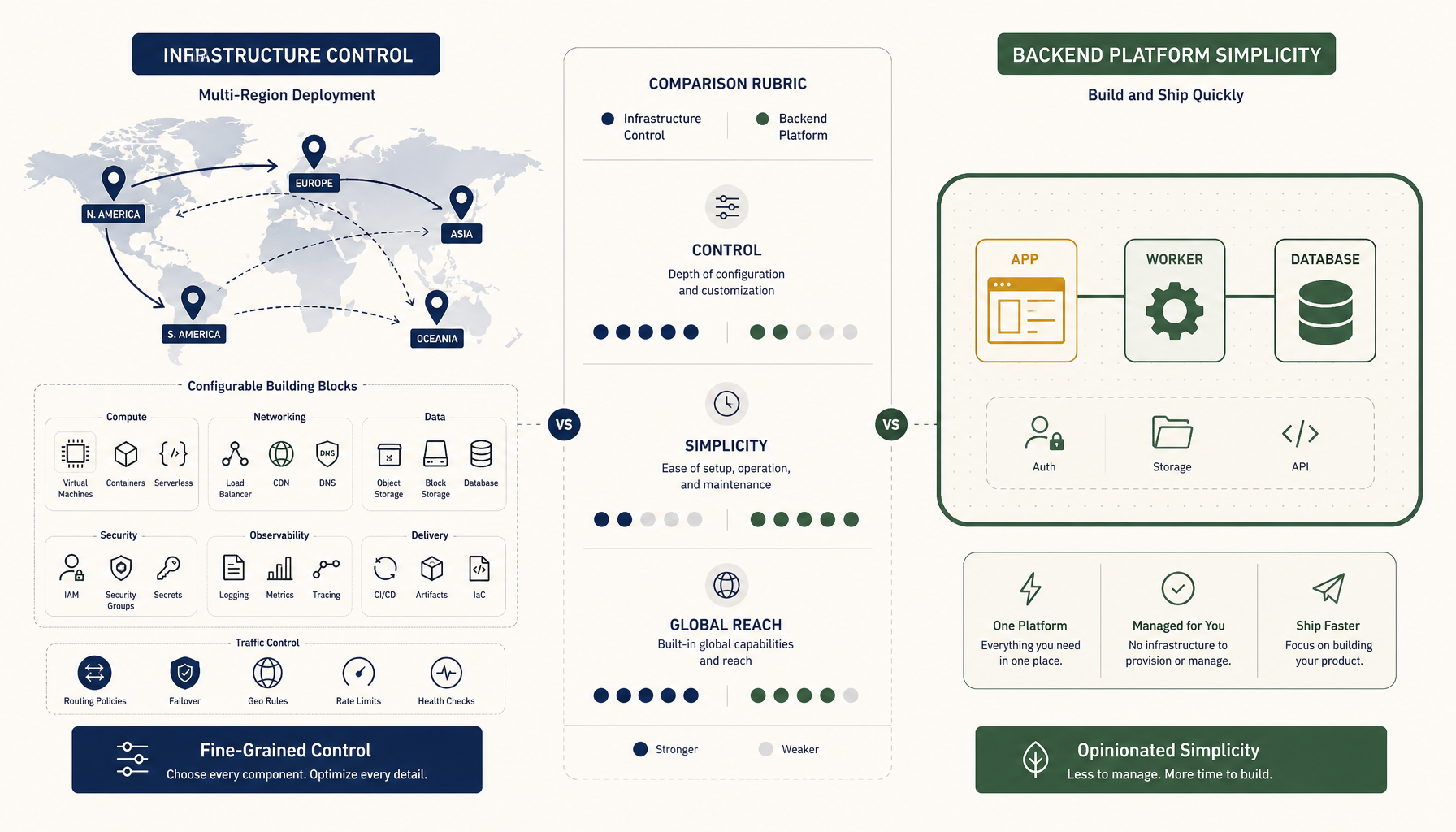
Quick answer: Pick Fly.io if you want multi-region deployment and are comfortable with more infrastructure control. Pick Railway if you want the simplest path to deploy backends with databases.
Comparison Table
| Criteria | Fly.io | Railway |
|---|---|---|
| Pricing model | Resource-based (CPU, RAM, bandwidth) | Resource-based ($5 min + usage) |
| Multi-region | Native, easy to configure | Single region default |
| Database | Fly Postgres (managed LiteFS) | Native Postgres, Redis, MySQL |
| Ease of setup | Medium (flyctl CLI) | Easy (git push, UI) |
| Best for | Global apps, latency-sensitive | Backends, databases, simplicity |
| Container support | Full Docker support | Full Docker support |
| Verdict | Best for global, infra-aware teams | Best for fast iteration |
Fly.io Overview
Strengths
- True multi-region deployment with minimal config
- Run containers close to users globally
- Excellent for latency-sensitive applications
- LiteFS for distributed SQLite
- More infrastructure control and visibility
Weaknesses
- Steeper learning curve than Railway
- CLI-first workflow (less UI polish)
- Managed Postgres requires more setup
- Bandwidth pricing can surprise you
- Less beginner-friendly documentation
Best for
- Apps needing global low-latency
- Teams comfortable with infrastructure concepts
- Real-time applications (games, collaboration)
- Edge-deployed services
Railway Overview
Strengths
- One of the simplest deployment experiences
- Native database provisioning in seconds
- Clean UI for environment management
- Great for teams and collaboration
- Predictable pricing for most workloads
Weaknesses
- Single region by default (latency tradeoff)
- Less infrastructure control
- Not designed for edge or multi-region
- Smaller ecosystem than Fly
- Limited customization for advanced use cases
Best for
- Backend APIs and services
- Full-stack apps with databases
- Teams prioritizing speed over global reach
- Projects that need Postgres, Redis, or MySQL fast
When to pick Fly.io
Pick Fly.io if:
- You need multi-region deployment
- Latency matters for your users globally
- You are building real-time or edge-first apps
- You want more control over infrastructure
- You are comfortable with CLI workflows
When to pick Railway
Pick Railway if:
- You want the fastest path to deploy
- Your users are mostly in one region
- You need databases without infrastructure work
- You prefer UI-driven workflows
- You are building a backend prototype or MVP
Verdict
Fly.io wins for teams that need global reach and are willing to invest in learning the platform. The multi-region story is significantly better than Railway, and you get more control over how your apps run.
Railway wins on simplicity. If you want to deploy a backend with Postgres in five minutes and your users are mostly in one region, Railway is the faster path.
For long-term cost control on stable workloads, consider whether a VPS gives you the best of both: control and predictable pricing.
Where to go next
Tutorials:
Related comparisons:
ServerCompass:
Final verdict
Fly.io
Fly.io wins for multi-region and infra control; Railway wins for simplicity and all-in-one UX.