Low-noise uptime checks: alert thresholds that survive a homelab full of services
Updated 2026-05-14
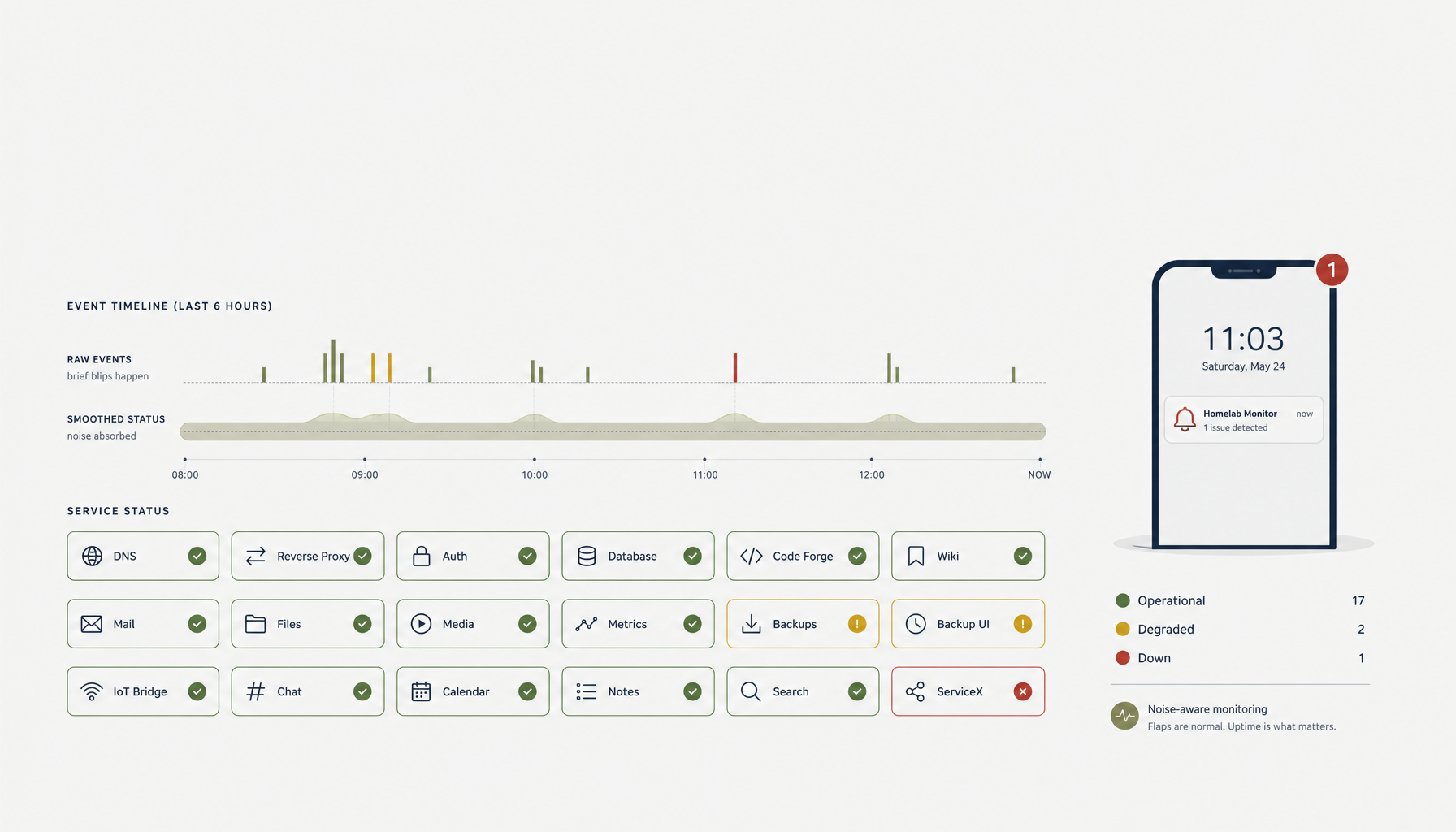
A homelab with twenty services is normal now. Pi-hole, Home Assistant, Jellyfin, Nextcloud, Vaultwarden, Immich, Paperless, Gitea, a couple of game servers, three monitoring tools watching the other seventeen — twenty isn't even ambitious. The problem is that every uptime tool, by default, treats those twenty services as twenty independent things to ping every 60 seconds with a single check, alerting on the first miss. Run that for a week and you'll get paged for a Pi-hole DNS blip at 3am, a Jellyfin transcoder hiccup during a movie, and a Gitea connection refused that resolved itself in eight seconds. Three weeks in, you're ignoring the channel — which is when the real Nextcloud outage will pass through silently.
The noise isn't a tool problem. Uptime Kuma, Gatus, Healthchecks, Statping, Cabot — all of them can be configured to quiet down. They ship loud because shipping quiet would mean opinionated defaults nobody agrees on. The shape of "low-noise but trustworthy" is consistent across communities though, and once you've configured it once you stop debating it. Four levers do almost all the work.
Lever 1 — agreement, not single-probe
The single biggest source of false alerts in homelab monitoring is a single check failing once and the alerter firing immediately. Network blips, brief CPU spikes, container restarts, NTP-driven brief unreachability — every one of these produces a transient failure that nobody needs to know about.
Replace single-probe with agreement. A service is only "down" if two consecutive checks fail, or if two checks from different vantage points fail in the same window. Both rules cut roughly 80% of transient noise without weakening real-outage detection.
Concretely:
- Two-consecutive-fail rule — the check has to fail twice in a row, with the standard interval between, before the state flips. For a 60-second check that means a service has to be down for ~120 seconds before you get a page. For Jellyfin, you genuinely don't care about 90-second outages.
- Multi-vantage agreement — if you have a second probe (a second Pi running Uptime Kuma, a small VPS, or even a tunnel back from a phone), require both to see the failure. Half of single-vantage outages are the monitor's network, not the service.
Most tools ship a setting for the first; the second requires running two probe instances. Both pay back the setup cost in the first week.
Lever 2 — flap suppression
The second source of noise is the service that goes up, down, up, down across two minutes — usually a container that's restarting, a port that's being rebound, or a TLS handshake that's racing a certificate refresh. Each transition is a separate alert. Five flaps in two minutes is five pages.
Flap suppression collapses the storm. The two patterns worth implementing:
- State debounce — when a service's status changes, lock the new state for N minutes before allowing another transition alert. N = 5 minutes is the homelab default; N = 15 minutes for noisy services like media transcoders.
- Alert suppression window — if more than M alerts fire for the same service in a rolling window, suppress further alerts and roll them up into a single "flapping" notification at the end of the window. M = 3 in a 10-minute window catches most flap storms.
Both keep the information (the service is misbehaving) while killing the page-count. Gatus and Uptime Kuma both support state debounce natively; alert suppression usually lives in your notifier (Apprise, ntfy, or a downstream rule in your channel of choice).
Lever 3 — tiered severity, not boolean
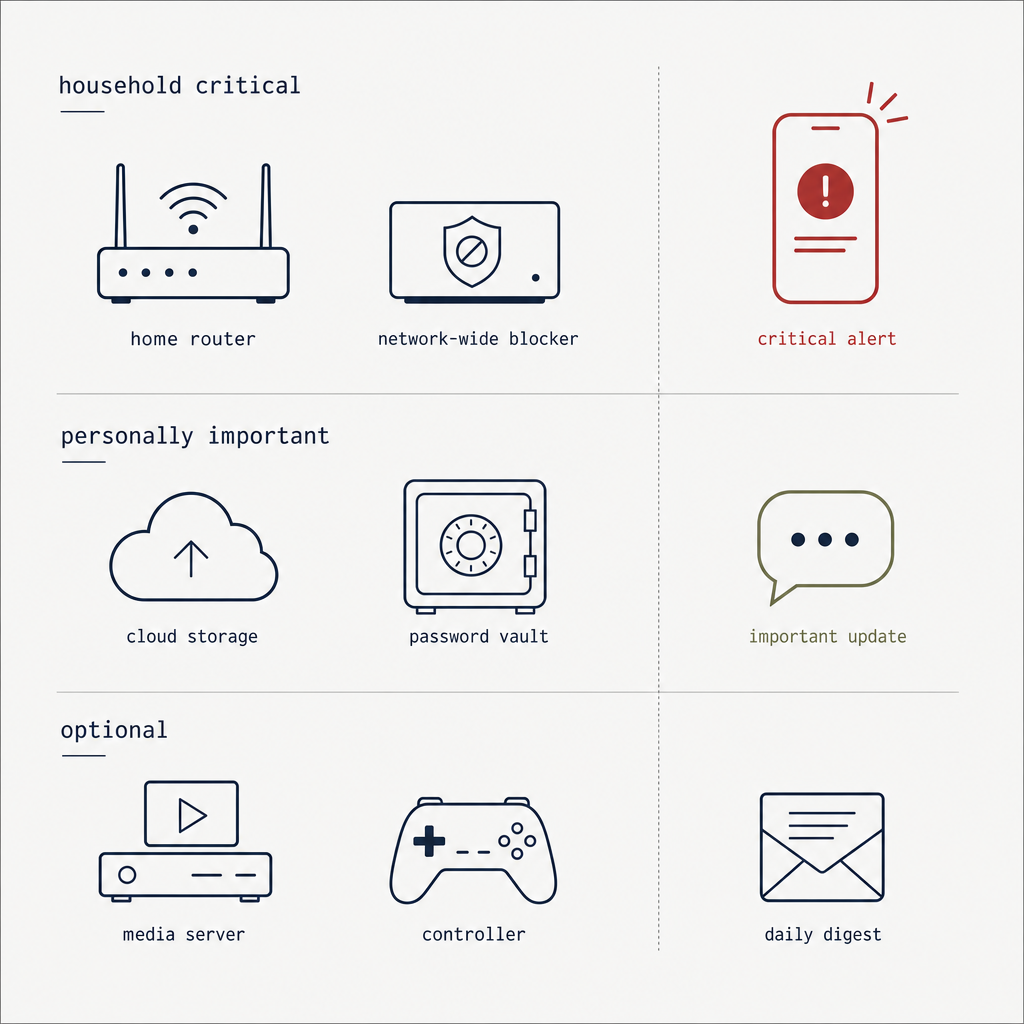
The instinct to treat "up" and "down" as the only two states is what makes operators page themselves for things that don't need a page. A homelab inventory naturally sorts into three tiers, and each tier wants a different alerting destination.
- Tier 1 — household critical. Pi-hole, the router, the firewall, the wireguard endpoint. If these are down for >2 minutes, you want a phone notification. Anyone in the house notices the outage within minutes anyway, so the alert is just the on-call confirmation.
- Tier 2 — personally important. Nextcloud, Vaultwarden, Immich, Paperless, Gitea, your blog. Down for >5 minutes should produce a notification to your monitoring channel — Slack, Discord, ntfy, whatever you actually read. Not a phone call.
- Tier 3 — fun but optional. Jellyfin, game servers, dashboards, lab utilities. Down for any length of time → no immediate alert. A daily digest at 9am that says "these things have been down for >12 hours" is plenty.
Most tools let you set per-monitor notification rules. The trap is treating this as a per-monitor decision instead of a tier decision — twenty per-monitor configs drift; three tier-templates don't.
Lever 4 — silence-by-default for new services
The last source of noise comes from new services. You spin up a new homelab toy, hook it into Uptime Kuma to "watch it," and now every container restart for the next week pages you while you're still tuning the service itself.
Make silence the default for new monitors. Concretely: every new monitor starts in Tier 3 (daily digest only) for the first 14 days. After 14 days, you've seen how it behaves and you promote it to the tier it actually deserves. Most Tier 3 services stay Tier 3 forever, which is fine.
A monitor that lives in Tier 1 should have justified its way there. Default-quiet plus deliberate promotion is the only policy that scales to twenty-plus services without burning the operator out.
Putting it together: a working ruleset
A homelab ruleset that survives twenty services looks roughly like this:
# All monitors
checks:
  interval: 60s
  fail_threshold: 2          # Lever 1 — two-consecutive
  recovery_threshold: 2      # don't flip back too eagerly
  state_debounce: 5m         # Lever 2 — flap suppression
  alert_burst_window: 10m
  alert_burst_max: 3

severity_tiers:
  household_critical:        # Lever 3 — Tier 1
    services: [pihole, router, wireguard]
    notify_after: 2m
    channels: [phone, ntfy_priority_max]
  personally_important:      # Tier 2
    services: [nextcloud, vaultwarden, immich, paperless, gitea, blog]
    notify_after: 5m
    channels: [slack_homelab]
  optional:                  # Tier 3
    services: [jellyfin, gameserver, dashboards, lab_*]
    notify_after: 12h
    channels: [daily_digest]

new_monitor_default_tier: optional   # Lever 4 — silence-by-default
new_monitor_quarantine_days: 14
This isn't a real format any single tool consumes. It's the shape of the policy you encode into whichever uptime tool you run. Translate each section into the relevant settings (state debounce, notification routing, default tags), and your alerts go from ten a week to three a week — with the three being real.
What to wire it into
Four tools cover the homelab uptime space well, with different tradeoffs (and one hosted option — ServerCompass — wires the four levers above into sensible defaults if you'd rather not maintain your own monitor):
- Uptime Kuma — the popular default. Good UI, good notifier coverage, supports interval + fail-threshold natively. Less elegant for multi-probe agreement (you run two instances and reconcile manually).
- Gatus — declarative YAML config, good for ops people who prefer git-managed configs to UIs. Supports conditional alerting ("alert if X failed AND Y didn't") which is useful for the multi-vantage rule.
- Healthchecks.io (self-hosted) — different model: services check in with the monitor on a schedule. Excellent for cron jobs and batch services; less natural for HTTP uptime.
- Apprise / ntfy — not monitors themselves; they're the notification layer. Both support the alert-burst suppression and priority routing you need to make tiered severity actually work.
A practical homelab stack picks one monitor (Uptime Kuma or Gatus) plus one notifier (ntfy + Apprise on top is the modal answer in 2026), wires them to the rule shape above, and stops re-tuning every two weeks.
Why this is worth doing once
Alert fatigue isn't a vibe. It's the predictable outcome of running a default-loud alerting system across a heterogeneous service inventory for more than a few weeks. The cost is real: you stop reading the channel, you miss the one alert that matters, and your homelab feels less reliable than it actually is.
The configuration above takes about an hour to set up the first time and ten minutes to re-apply when you add a new service. After three weeks, your alert count drops by roughly an order of magnitude, and the alerts that remain are the ones you want.
It's not a tool problem. It's a policy problem with a known shape — agreement, flap suppression, tiered severity, silence-by-default — and the homelab community has converged on this exact shape from the bottom up. Pick a monitor that supports the four levers, encode the policy, and stop debating it. The point of running services at home is using them, not babysitting an alerting channel.