DigitalOcean Alternatives (2026): Better Value Exists
Updated 2026-05-14 · 10 min
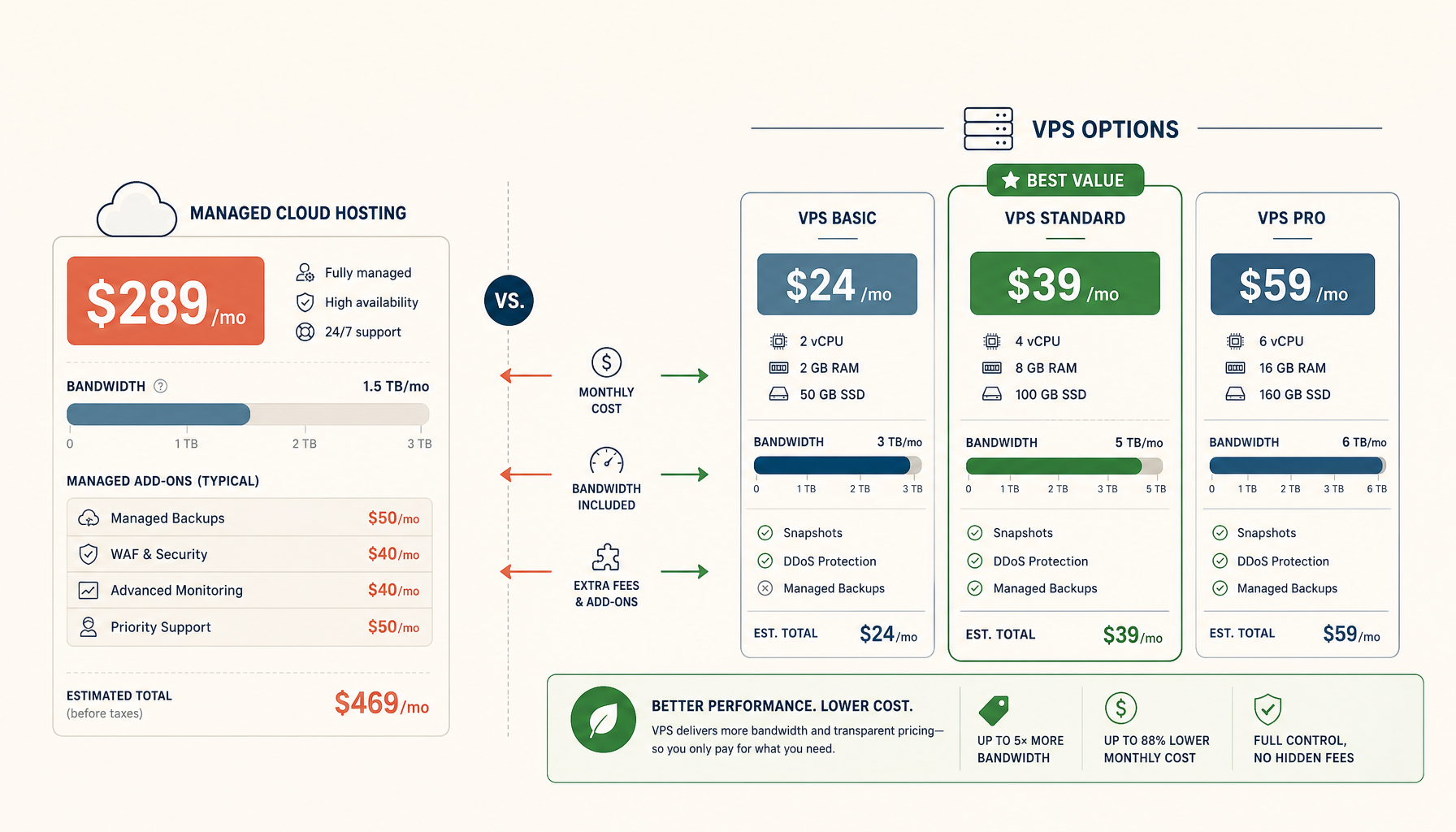
DigitalOcean defined "developer-friendly cloud" for a decade. Simple pricing, clean UI, and documentation that actually helped.
But the landscape shifted. DigitalOcean is no longer the value leader, and their managed services (App Platform, Managed Databases) are priced like premium products.
If you are re-evaluating your hosting, here are the real options.
Why developers leave DigitalOcean
- Pricing is no longer competitive. A basic Droplet costs $6/month. The same specs on Hetzner cost $4.50 with more bandwidth included. The gap widens at every tier.
- Managed services are expensive. Managed Postgres starts at $15/month for the smallest instance. Self-hosting or using Hetzner's equivalent saves significant money.
- App Platform is overpriced. DigitalOcean's PaaS offering costs more than Railway or Render for similar functionality.
- Bandwidth costs add up. DigitalOcean includes 1TB on basic plans. Hetzner includes 20TB. If your app serves traffic, this matters.
The comparison table
| Option | Best for | Cost signal | Trade-off |
|---|---|---|---|
| Hetzner | raw value, European presence | $4-$50/mo | fewer regions |
| Vultr | DigitalOcean-like UX, more regions | $5-$60/mo | smaller community |
| Linode (Akamai) | similar to DO, Akamai network | $5-$60/mo | corporate parent |
| AWS Lightsail | AWS ecosystem access | $5-$80/mo | less intuitive |
| Self-managed VPS | maximum control | VPS cost | ops on you |
Alternative 1: Hetzner (the new value king)
Hetzner is what DigitalOcean used to be: aggressive pricing, solid performance, and no-nonsense infrastructure.
Where it wins:
- 30-50% cheaper than DigitalOcean at every tier
- 20TB bandwidth included (vs 1TB on DO)
- ARM64 servers for even better value
- Excellent network performance in EU and US
Where it loses:
- Fewer regions (EU-centric, expanding to US)
- UI is functional but not beautiful
- Smaller ecosystem of managed add-ons
When to pick it:
- Cost is your primary concern
- EU latency works for your users
- You are comfortable with basic server management
The Hetzner CAX11 (ARM) at $4.50/month outperforms a DigitalOcean $12 droplet for most workloads. The value gap is not small.
Alternative 2: Vultr (closest DigitalOcean experience)
Vultr is the most similar to DigitalOcean in UX and positioning. If you want a swap without adjusting your mental model, Vultr is it.
Where it wins:
- Clean, familiar interface
- More regions than Hetzner
- Competitive pricing (usually 10-20% less than DO)
- Good API and automation support
Where it loses:
- Not as cheap as Hetzner
- Support can be slow
- Fewer managed service options
When to pick it:
- You want a DigitalOcean-like experience
- You need specific regions Hetzner does not cover
- You value UI polish
Alternative 3: Linode (Akamai)
Linode was the original "simple cloud" provider. Now owned by Akamai, it has enterprise backing without losing its simplicity.
Where it wins:
- Akamai's network backbone (serious global presence)
- Pricing competitive with DigitalOcean
- Strong community and documentation
- Managed Kubernetes if you need it
Where it loses:
- Corporate ownership brings uncertainty
- Fewer innovations recently
- UI feels dated compared to newer providers
When to pick it:
- You want enterprise stability
- Global CDN integration matters
- You have existing Akamai relationships
Alternative 4: AWS Lightsail (if you might need AWS later)
Lightsail is AWS's answer to DigitalOcean: simple, predictable VPS pricing without the AWS complexity.
Where it wins:
- Predictable flat pricing (unlike regular EC2)
- Easy path to full AWS services
- Global region availability
- Native integration with Route 53, S3, etc.
Where it loses:
- AWS complexity leaks through eventually
- Support requires paid plans
- Less developer-friendly than purpose-built providers
When to pick it:
- You know you will need AWS services eventually
- You want to stay in one ecosystem
- Your team already knows AWS
Alternative 5: Stay on DigitalOcean (when it makes sense)
DigitalOcean is not bad. It is just no longer the default recommendation.
When to stay:
- You use DigitalOcean Kubernetes (DOKS) heavily
- You have significant credits or contracts
- Your team knows the platform deeply
- You need their specific managed services
When to leave:
- You are paying more than you should for basic compute
- Bandwidth overage fees are hitting your bill
- You want better value without sacrificing quality
The VPS migration pattern
If you are moving from DigitalOcean to another VPS provider, the pattern is simple:
- Spin up a new server on target provider
- Install Docker and your reverse proxy
- Deploy your stack with Docker Compose
- Update DNS to point to new server
- Verify, then tear down old infrastructure
The actual migration takes an afternoon. The cost savings compound monthly.
Verdict: what I recommend in 2026
For most teams: Hetzner wins.
The value is not close. You get more compute, more bandwidth, and lower costs. The only real tradeoff is region availability, and that is improving.
If you need more regions: Vultr is the safe choice with a similar experience to what you know.
If you might scale into AWS: Start with Lightsail and grow into the full platform.
DigitalOcean had a great run as the developer-friendly cloud. That crown now belongs to Hetzner for value and to providers like Railway and Fly for managed simplicity. Know what you need, pay for what you use.
Where to go next
Tutorials:
Comparisons:
ServerCompass:
Related in the StoicSoft network
If you're choosing a VPS provider or benchmarking real-world performance like the post above explores, StoicVPS is the StoicSoft network's independent tracker for VPS pricing, performance, and migration safety.